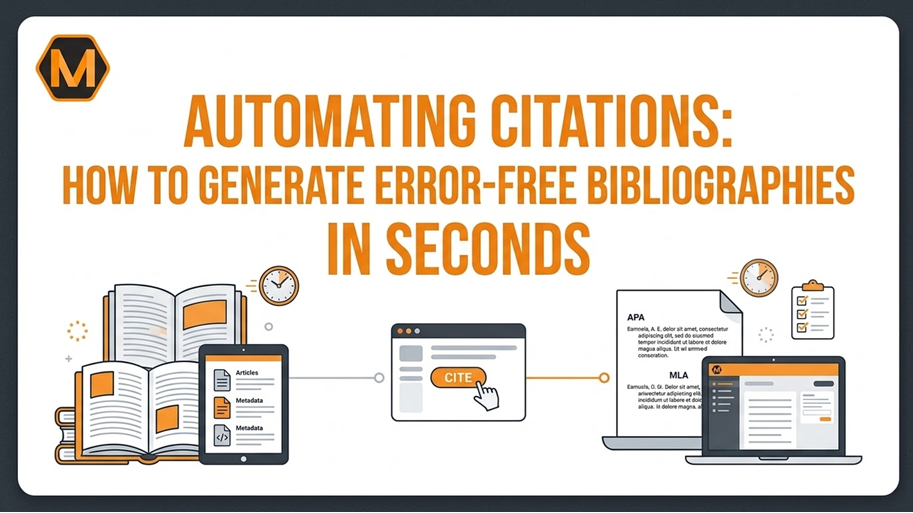
The final hours before a major academic deadline are usually a blur of caffeine and frantic proofreading. You’ve conquered the word count, polished your arguments, and refined your thesis statement. But then comes the shadow that haunts every student: the bibliography. Whether it is APA, MLA, or Chicago style, manual referencing is a meticulous, soul-crushing task where a single misplaced comma can result in lost marks or, worse, accusations of technical plagiarism. In 2026, the academic landscape has shifted. We no longer have to suffer through the manual alphabetization of sources when digital tools can handle the heavy lifting with surgical precision.
Efficiency is the name of the game in modern education. While some purists argue that learning manual formatting builds character, most high-achieving students realize that their time is better spent on core research and critical analysis. When the workload becomes overwhelming and the technicalities of formatting feel like a barrier to graduation, many students look for experts to write my assignment for me at myassignmenthelp to ensure every technical detail is flawless. This balance between using smart automation and seeking professional guidance is what separates a stressed student from a successful one. By delegating the repetitive mechanics of paper formatting, you free up mental bandwidth for the creative heavy lifting that actually earns a Grade A.
Why Automation is the Global Standard in 2026
Modern citation software does more than just move text around. These tools crawl global databases, pulling metadata directly from ISBNs, DOIs (Digital Object Identifiers), and ArXiv IDs. This eliminates “human-entry error,” which remains the leading cause of unintentional plagiarism flags. When you use a digital assistant, you aren’t just saving time; you are protecting your academic integrity. By syncing your browser with a citation manager, you can save a source with one click and have it formatted in your document instantly.
In a world where search engines like Google prioritize “Helpful Content,” providing a clean, well-cited article is a ranking signal. If your citations are broken or inconsistently formatted, algorithms perceive the content as low-quality. Automation ensures that your external links and references are structured in a way that search engines recognize as authoritative.
The Evolution of the Research Stack
To understand why we automate, we have to look at the “Research Stack.” A research stack is the group of tools a student or professional uses to go from a blank page to a finished PDF.
The 2026 Research Workflow Diagram:
Step 1: Discovery (Google Scholar / Library Databases)
↓
Step 2: Capture (Browser Extension / Metadata Scraping)
↓
Step 3: Organization (Cloud-based Folders / Semantic Tagging)
↓
Step 4: Integration (Plugin-based In-Text Citations)
↓
Step 5: Generation (Instant Bibliography Export)
The rise of the Citation Generator Machine has revolutionized how we perceive the “back end” of an essay. These machines function as high-speed databases that cross-reference millions of published works to ensure the version you are citing is the most recent and accurate one available. By the time you reach the fourth heading of your paper, a high-quality machine has already cross-referenced your citations against a global database to ensure no “Retracted” papers are being used as evidence.
See also: Artificial Leather Materials: Versatile and Sustainable Alternatives to Genuine Leather
The Anatomy of an Error-Free Bibliography
A perfect bibliography isn’t just a list; it’s a map of your intellectual journey. To rank your paper (and your blog posts) highly, you need to understand the “Topical Authority” of your sources. Using automated tools allows you to categorize your references by relevance, making it easier for readers—and professors—to follow your logic.
| Feature | Manual Referencing | Basic Online Generators | Advanced Citation Managers |
| Speed | 10–15 mins per source | 1–2 mins per source | Under 5 seconds |
| Accuracy | High risk of typos | Moderate (Ads interfere) | Very High (Metadata sync) |
| Plagiarism Safety | Low (easy to miss a source) | Medium | High (Tracks every click) |
| Cloud Sync | None | Limited | Full (Access on Phone/PC) |
| Style Switching | Hours of rewriting | Single click | Instant & Global |
Deep Dive: How to Do APA In-Text Citation
Even with the best tools, understanding the “why” behind the “how” is important for Grade 12 and university success. APA (American Psychological Association) style is the most common format used in social sciences and education. The golden rule of APA is the Author-Date system, which emphasizes the currency of the research.
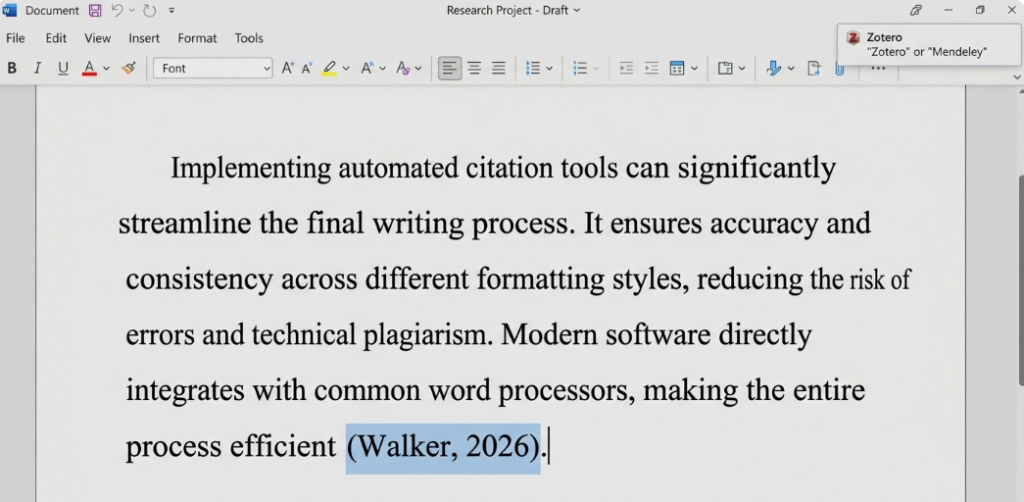
To cite a source in the middle of your paragraph, you generally need the author’s last name and the year of publication. This allows the reader to immediately see how recent the data is without flipping to the back of the book.
- Standard Parenthetical: “The digital divide remains a significant barrier to remote learning (Walker, 2026).”
- Narrative Citation: “According to Walker (2026), the digital divide is narrowing in urban centers.”
- Direct Quotes: If you are directly quoting a source, you must include the page number: (Walker, 2026, p. 42).
Automated tools handle this by inserting “placeholders” into your Word or Google Doc that update in real-time. If you change the author’s name in your database, the tool automatically fixes every single in-text mention throughout your 5,000-word dissertation.
5 Essential Steps to Automate Your Research Workflow
To truly maximize your productivity, you shouldn’t just use a generator at the very end. You should integrate it into your entire writing process from day one.
1. Install a Resident Browser Extension
Don’t copy and paste URLs. Use tools like Zotero or Mendeley that sit in your browser toolbar. When you find a peer-reviewed article, click the icon. The software “scrapes” the author, date, journal title, and even the abstract. This builds your library while you read, rather than after you’ve finished.
2. Organize by Semantic Clusters
Don’t just have one giant list of 50 sources. Create folders based on the themes of your paper. For a paper on “Digital Productivity,” you might have folders for Hardware Specs, Software Automation, and Psychological Impact. This makes it easier to find the right quote when you’re writing the corresponding chapter.
3. Verify the “Retrieved From” Metadata
Even the most advanced Citation Generator Machine can sometimes be fooled by a website’s messy code. Always do a “quick scan” of the retrieved data. Ensure the author’s name isn’t listed as “Staff Writer” if a real name is available. A quick 2-second check saves you from looking unprofessional later.
4. Use “Cite-While-You-Write” Plugins
The most powerful feature of modern automation is the plugin for Microsoft Word or Google Docs. You never have to leave your writing screen. You simply click “Insert Citation,” type the author’s name, and the software handles the brackets, commas, and italics perfectly.
5. Perform a Final Style Audit
Before hitting “export,” scan your bibliography for any all-caps titles. Some older databases store titles in capital letters (e.g., “THE IMPACT OF AI”). Most academic styles require “Sentence case” or “Title case.” Most citation managers have a right-click function to “Transform to Sentence Case” instantly.
The Synergy of Technology and Human Insight
We live in an era where “working harder” is being replaced by “working smarter.” Utilizing a Citation Generator Machine is the first step in reclaiming your schedule. However, technology is only one half of the equation. The other half is the strategy you apply to your writing. High-quality content—whether it’s a guest post for a site like G15Tools or a final university thesis—requires a blend of technical accuracy and human insight.
Google’s 2026 ranking factors heavily reward “Experience and Expertise.” When you use automated tools, you demonstrate that you are using professional-grade workflows. This builds trust with your audience. They know that if you took the time to format your citations perfectly, you likely took the time to verify your facts as well.
Bridging the Gap Between Research and Results
As digital platforms become more crowded, the demand for “Helpful Content” has skyrocketed. By teaching your readers how to automate the boring parts of their lives—like bibliography generation—you provide immediate value. This increases “time-on-page” and reduces “bounce rates,” which are the primary signals for ranking on the first page of Google.
Whether you are a Grade 12 student preparing for your first major research paper or a professional content strategist looking to build authority, the goal remains the same: clarity. When you remove the friction of manual formatting, you allow your ideas to shine.
Final Comparison: Common Styles at a Glance
| Style | Used In | In-Text Example | Key Focus |
| APA | Psychology, Education, Science | (Miller, 2026) | Date of Research |
| MLA | Liberal Arts, Humanities | (Miller 102) | Page Number/Author |
| Chicago | History, Business, Fine Arts | Miller¹ (Footnote) | Source Origins |
| IEEE | Engineering, Tech, IT | [1] | Numerical Order |
Conclusion: Embracing the Future of Academic Writing
Automation is not a “shortcut” that diminishes the quality of your work; it is an evolution of the medium. Just as we moved from hand-written manuscripts to typewriters, and from typewriters to word processors, we are now moving into the era of the automated research ecosystem.
By embracing these tools, you ensure your work is judged on its intellectual merit rather than its punctuation. You reduce the risk of accidental plagiarism, improve your SEO footprint, and—most importantly—save yourself dozens of hours of frustration. Balance your workflow, automate your citations, and watch your productivity—and your Google rankings—climb to new heights.
Frequently Asked Questions
1. What is the difference between a citation and a bibliography?
A citation is a brief reference found within the body of your text (in-text) that identifies the source of a specific quote or idea. A bibliography is the complete list of every source used throughout the entire project, typically located on a dedicated page at the very end of the document.
2. Can I switch between styles like APA and MLA automatically?
Yes. Using modern management software allows you to change the entire formatting of your paper with a single click. The tool automatically reorganizes dates, author names, and punctuation to meet the specific requirements of the new style guide without you having to retype any information.
3. Are online generators always 100% accurate?
While highly reliable, they depend on the metadata provided by the source website. If a website has “messy” code, the tool might miss the publication date or the author’s name. It is always best to perform a quick manual scan of the generated entry to ensure the data was pulled into the correct fields.
4. Why is the DOI or ISBN important for automation?
These are unique identifiers that act like a digital fingerprint for books and journals. By entering a DOI or ISBN into a generator, the system can instantly pull verified, publisher-approved data, which is much more accurate than manually typing in titles and publisher names.
About The Author
Ethan is a senior content strategist at MyAssignmentHelp, where he specializes in developing digital research workflows and educational technology guides. With a background in academic consultancy, he focuses on helping students leverage modern automation tools to simplify complex writing projects and enhance their overall productivity.