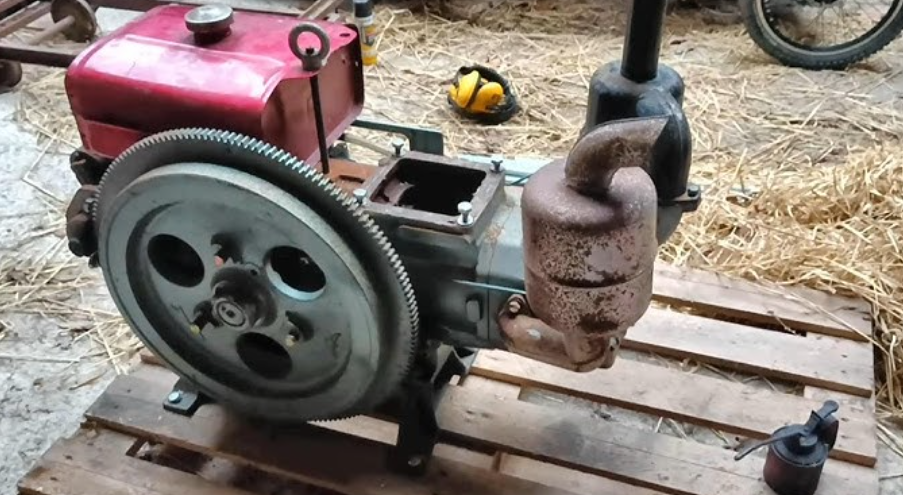
The term spring starter motor describes the complete assembly that stores, controls, and delivers mechanical energy to crank an engine—a technology that differs fundamentally from electric motor starters yet serves the same essential function. Understanding how this assembly works and how to select the right configuration for your application is essential for anyone specifying industrial starting equipment.
Components of the Spring Starter Assembly
A spring starter motor assembly consists of several integrated subsystems, each performing a specific function:
- Spring assembly: the energy storage element, a precision-wound coil spring
- Housing: the structural enclosure that contains the spring under tension
- Winding mechanism: ratchet and crank system for manually compressing the spring
- Release mechanism: the latch that holds energy until intentionally triggered
- Drive assembly: pinion gear and overrunning clutch that engage the engine
- Output shaft: transfers rotation from spring to drive assembly
The quality and precision of each component affects overall system performance. Compromises in any subsystem reduce the reliability of the whole assembly.
Performance Parameters to Understand
Energy Storage Capacity
Measured in Joules, this parameter defines how much mechanical work the spring can store. Higher energy storage enables starting of larger engines or providing more starting attempts per winding. The relationship between energy storage and engine size is established through the engine’s cranking torque requirement and the minimum cranking speed needed for ignition.
Torque Output Curve
Unlike electric motors that deliver relatively constant torque, spring starters deliver a decreasing torque as the spring unwinds. The design challenge is ensuring that sufficient torque is available through the full cranking sequence—from initial engagement against a static engine through the acceleration phase. A well-designed spring starter provides ample torque at the beginning of the cycle when resistance is greatest.
Engagement Speed
The speed at which the drive pinion engages the ring gear affects both starting success and component longevity. Engagement speed must be sufficient to achieve the minimum cranking RPM but not so violent as to cause premature ring gear or pinion wear.
Selecting the Right Configuration
Several configuration factors influence spring starter selection. Single spring designs suit moderate-displacement engines and frequent starting cycles. Dual-spring configurations provide additional energy for larger engines. The winding mechanism design—manual crank, lever, or integrated hydraulic assist—must match the operator capability and access constraints of the installation.
The drive assembly geometry must match the engine’s flywheel ring gear specifications. Most manufacturers offer multiple drive configurations to accommodate the range of standard and non-standard ring gear geometries encountered in industrial applications.
See also: What Is Blockchain Technology
Integration with Safety Systems
In many industrial installations, the spring starter motor is integrated with automated safety and control systems. Position sensors verify engagement and release, while safety interlocks prevent starting under unsafe conditions. These integrations should be specified during the selection process to ensure the chosen spring starter has the necessary interface provisions.
Testing and Commissioning
After installation, proper commissioning of the spring starter system is essential. Commissioning should include verification of correct mounting and alignment, confirmation of proper engagement depth, functional testing of the release mechanism, documentation of performance parameters, and training for operations and maintenance personnel.
Frequently Asked Questions
What is the difference between a spring starter motor and a hydraulic starter?
A spring starter stores energy mechanically in a compressed spring with no required external infrastructure. A hydraulic starter uses pressurized hydraulic fluid and requires a hydraulic pump, reservoir, and distribution system. Spring starters are self-contained; hydraulic starters require supporting infrastructure.
Can spring starter motors be automated?
Some models incorporate automatic spring winding mechanisms that recharge the spring during engine operation, enabling fully automatic restart capability. These are particularly valuable for unattended remote installations.
How do I interpret the model number of a spring starter motor?
Manufacturer model numbers typically encode key specifications such as energy storage capacity, configuration type, and drive geometry. Consult the manufacturer’s product catalog or technical support team to interpret specific model numbers.
Conclusion
The spring starter motor is a precisely engineered assembly whose performance depends on the quality of its constituent components and the care with which it is applied, installed, and maintained. Understanding the key performance parameters—energy storage, torque output curve, and engagement characteristics—enables confident specification decisions that deliver reliable engine starting across the full range of industrial applications.